

Let’s be honest. Nobody gets into healthcare to spend their day chasing appointment confirmations, correcting billing mistakes, or searching through a filing cabinet for a patient record that should have been easy to find. And yet, that is exactly how a large chunk of the working day disappears in clinics that are still running on manual systems. Clinic management software was built to fix that.
we are starting here because this is where most clinic owners and hospital managers start too. They know something is not working as well as it should. They have heard people talking about going digital. But they are not entirely sure what that actually means in practice, what it would change inside their clinic, or whether it is worth the effort of switching. So let us walk through it properly.
What Healthcare Management Software Actually Is ?
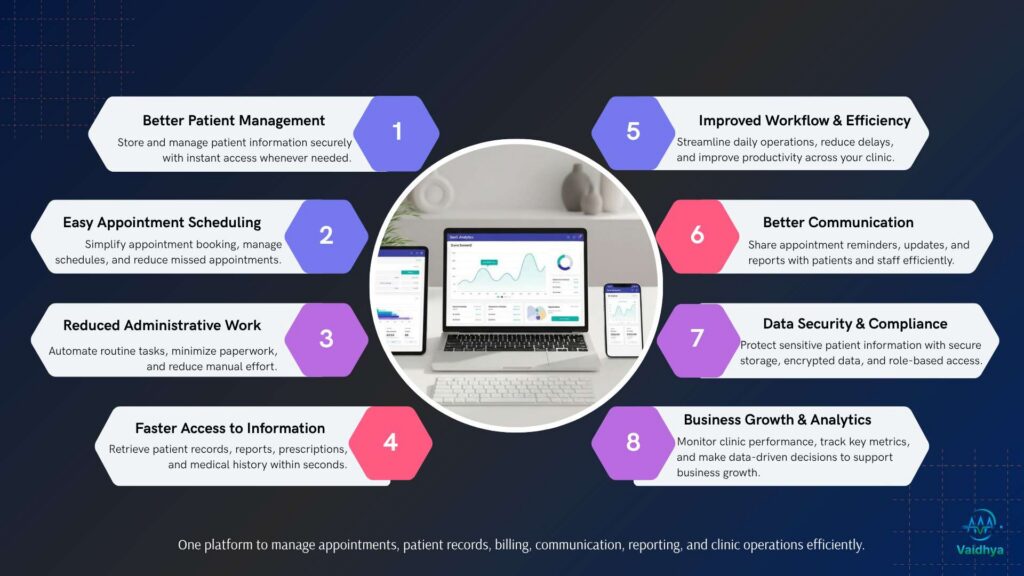
At its simplest, healthcare management software is a single digital platform that handles everything that keeps a clinic running outside of the clinical care itself.
Right now, most clinics are managing these things across multiple places. Appointments in one system. Patient files in another. Billing somewhere else entirely. And a whole lot of things getting tracked in someone’s memory or on a piece of paper that will eventually get lost. Healthcare management software brings all of that into one place and keeps it organized, accurate, and accessible to the right people at the right time.
In practical terms, a good platform covers:
-
- Appointment scheduling: booking, rescheduling, and automated reminders sent directly to patients
-
- Patient records: a complete, organized digital history for every patient including visits, prescriptions, test results, and clinical notes
-
- Billing and payments: automated invoicing, payment tracking, and far fewer manual errors
-
- Team coordination: tasks assigned, tracked, and completed through the system rather than passed around verbally
-
- Performance reporting: real data about how the clinic is running, available whenever you need it
Some platforms go further and include telemedicine, AI-assisted documentation, or inventory management. But even at its core, the value is significant.
Why Manual Systems Eventually Break Down ?
Here is something worth saying plainly, manual systems do not fail dramatically. They fail gradually. And that is actually what makes them harder to walk away from. A clinic running on spreadsheets and paper files can function for years. Things get managed. Patients get seen. Bills go out. But underneath all of that, small problems are building up. A double booking here. A missing record there. A billing error that takes three weeks to catch. A doctor who had to spend the first ten minutes of a consultation figuring out what medication the patient is actually on because the notes were not updated.
None of these feel like crises. But they add up. They slow the day down. They stress the team out. And they quietly affect the quality of care that patients receive not because the doctors are not capable, but because the system around them is not giving them what they need. That is exactly what clinic management software is designed to change.
What Changes When You Make the Switch ?
The first thing clinic owners notice after moving to a proper digital system is not some dramatic operational transformation. It is smaller than that and more meaningful.
The day starts with a clear, accurate schedule. Patient records are ready before the appointment begins. Reminders have already gone out automatically. Billing is being tracked in the background. Nobody is scrambling to get organized because the system has already done it.
For doctors, this shows up most clearly in the consultation room. Walking in with a complete, up-to-date picture of the patient, their history, their medications, their last visit, their test results, changes the quality of that appointment. Less time asking questions the notes should already answer. More time actually focused on the person in front of them.
For managers, the shift is about visibility. When everything runs through one system, you stop finding out about problems after they have already caused damage. You can see where things are slowing down and also you know what the revenue pipeline looks like. It have real information to make real decisions with, instead of piecing things together at the end of the week.
How It Directly Helps Your Team?
Burnout is a real and serious problem in healthcare right now, and one of the biggest contributing factors is this, skilled, trained people spending enormous amounts of their working day on tasks that have nothing to do with why they entered the field.
A well-implemented patient management system takes the most repetitive administrative work off their plate entirely:
-
- Patient reminders go out without anyone making a single phone call
-
- Records update across the system in real time
-
- The system tracks and flags follow-up schedules automatically.
-
- Reports generate without anyone sitting down to build them manually
Give a doctor back two hours a day of time they were spending on admin and watch what happens. They are less stressed, more present with patients and make better decisions. The same applies across your whole team. Better systems do not just improve operations, they improve people.
Is the Setup as Complicated as It Sounds?
This is the question that holds most clinic owners back, and it deserves a straight answer.
Yes, there is an upfront effort. Migrating existing records, training staff, and setting up workflows to match how your clinic actually operates takes time. It is not something that happens overnight. But it is also not as disruptive as most people expect. Modern healthcare management software provides an intuitive interface, and a reliable provider guides your team through every step instead of leaving you to manage the process alone.
Every clinic that goes through it says the same thing. The transition was easier than they thought. And they wish they had done it a year earlier.
Start with the Best Healthcare Software Solutions → Start with Vaidhya.ai
Healthcare management software helps clinics of all sizes improve efficiency, not just large hospital networks. It is for any clinic that wants to stop working harder than it needs to, serve patients better than it currently does, and build something that can actually grow.
At Vaidhya.ai, we build healthcare technology around the way real clinics operate not the way a textbook says they should. Our platform covers everything from appointment management and patient records to AI-assisted documentation and clinic performance analytics, all in one place, designed for the Indian healthcare environment.
If you have been thinking about making the switch, this is a good place to start.
FAQs
1. What is healthcare management software?
A digital platform for managing appointments, records, billing, and daily clinic operations.
2. Who is it designed for?
Clinic owners, hospital administrators, and healthcare teams of any size.
3. Does it replace existing clinic staff?
No, it supports staff by removing repetitive administrative work from their day.
4. How soon can a clinic see results?
Most clinics experience efficiency gains within the first couple of weeks of going live.
5. Is Vaidhya.ai good for small clinics?
Yes, it is designed to work for single practice clinics and growing hospitals.